
Unit Conversions Part 2: Ratio Table Method

Hi folks!
This is the third blog in a series on units. If you want to go from the very beginning, start here, which explains how we break down types of unit and prefixes to our students, and then find last week’s part here. Once you’ve done that, we can crack on with consistent conversion (that’s two alliterations already this term, blimey!)
You will be bewildered, I’m sure, to find out that a new-wave maths teacher, in fact, uses a ratio table. I know! I hope you were sitting down when you read that to get over the shock!
Now, it’s still not a given in this day and age for some to be unaware of the ratio table. So, let’s break it down, using the example of centimetres to metres. First off, we’ll convert 250cm to metres.
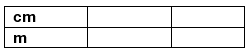
We start by drawing the table
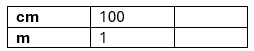
Next, we’ll fill in the fact we already know, that 100cm = 1m
We’ll then put in the number from the question, making sure of course to put it in the correct row

Next job is to decide which direction to travel: horizontally or vertically. There is no ‘wrong’ decision here, but there will usually be an easier and harder one. Looking at these numbers, I would say your average class would move vertically. 100 becoming 1 seems nicer than 100 becoming 250

Which eventually leads us to our correct answer

But as I say, sometimes going horizontally could be even easier. Let’s try 300cm
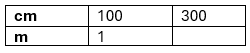
Suddenly, all I have to do to move horizontally is multiply by 3
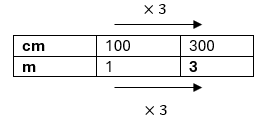
Whether getting larger or smaller, going upwards or downwards, left or right, it doesn’t matter. If the units are consistent, and you’re travelling orthogonally, it will always work!
But, what about weird unit conversions? Well, let’s have a look.
Let’s say we want to convert 35cm to mm. And it doesn’t matter how many time you tell them to look at their ruler, they act as though you’re speaking Flemish! And you get hundreds and thousands like you’re in an ice cream parlour! Well, let’s use that to our advantage. When setting out the ratio table, this is what you get them to do:
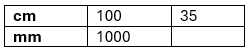
Suddenly, all they have to do is travel vertically, and they’re multiplying by 10 to get 350. Just think about how many headaches this can solve!
Even better, this method works for currency conversions, metric to imperial, best buys, any direct proportional reasoning at all! Don’t believe me? Grab a textbook/worksheet, and give it a try!
What’s that? You want to turn km into cm? No problem, just use 2 tables! 2.5km to cm:
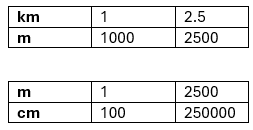
Voila, 250,000 cm
2 days to minutes?
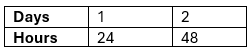
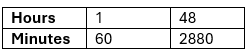
Have a play around with these, and let me know any feedback! I would also love if you shared this with any primary friends, as this can obviously be a game changer. And just think, you might actually have a year 7 crop who have seen a ratio table before!
Next week, we will be looking at the wonderful world of compound measures, where suddenly we have lots of units to consider!
Until then, thank you and see you next week!